The Context Engine
Architecture of an AI-Native SystemAbstract: True Artificial Intelligence requires computational power that exceeds the thermal and electrical limits of consumer hardware. This paper outlines the architecture of Augean, an AI-Native application designed not to compute intelligence locally, but to act as a high-fidelity interface for Google's Gemini models. We explore the definition of "AI Native" as the optimization of the data pipeline between the user's local GEDCOM database and the 42-Exaflop compute clusters that power modern LLMs.
1. Defining "AI Native" Topology
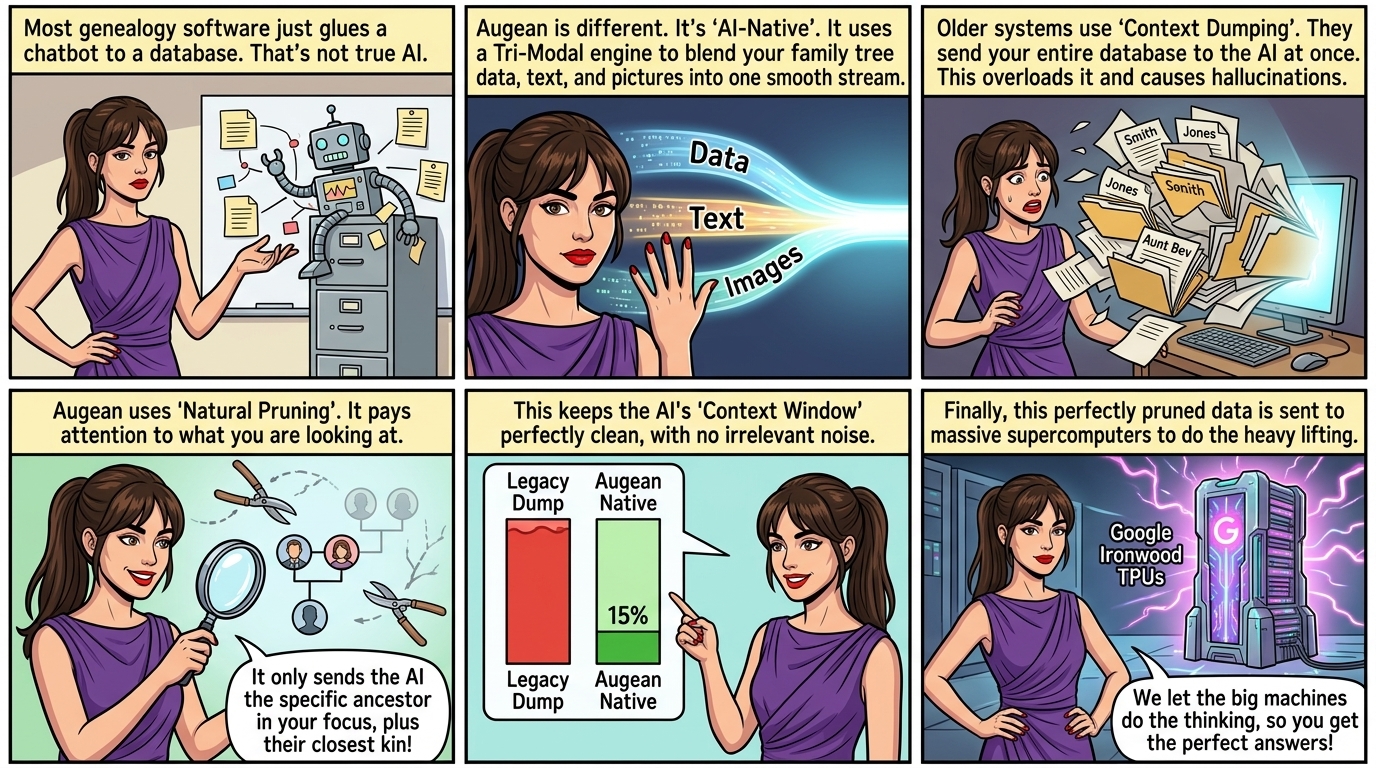
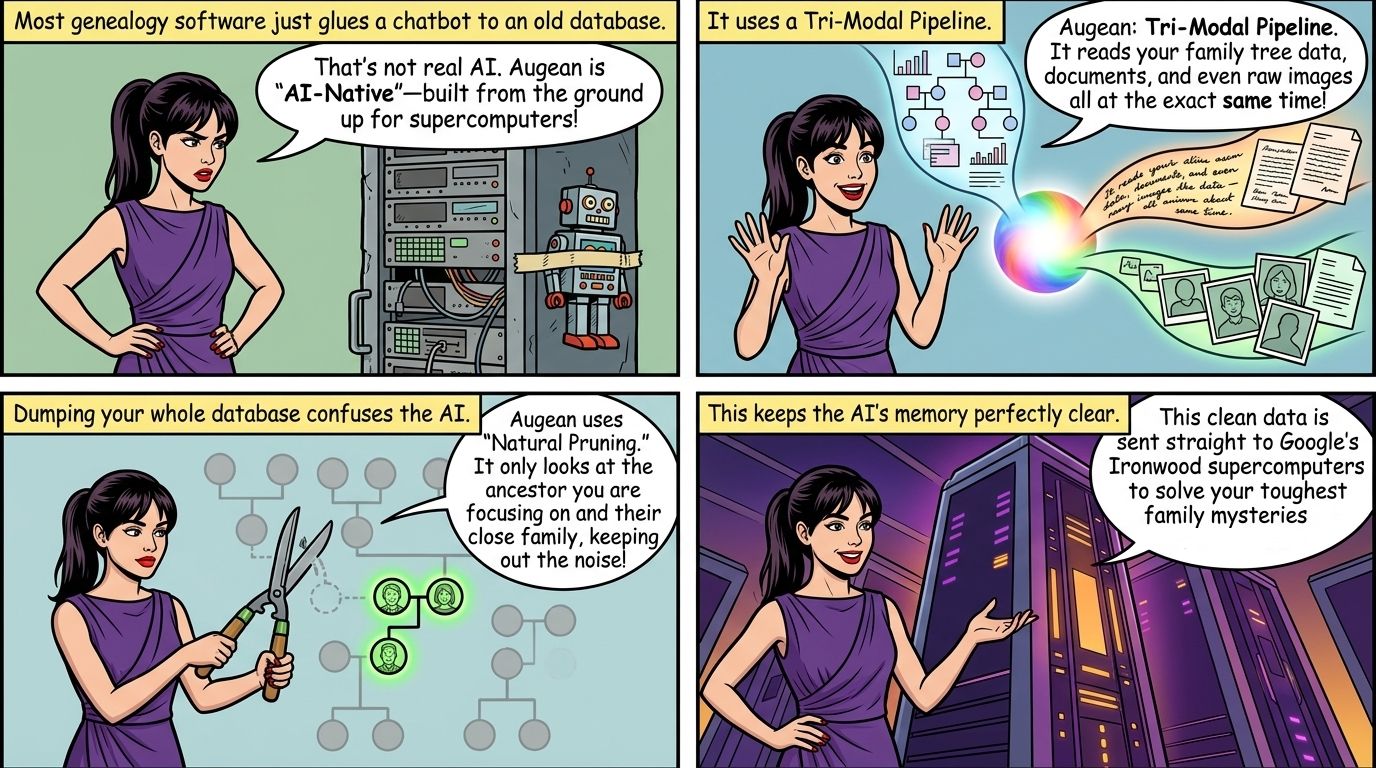
Most legacy genealogy software treats AI as an add-on—a chatbot glued to the side of a database. This is not AI Native.
Augean is AI Native because its fundamental data topology is designed for the Large Language Model first. It does not wait for a prompt. Instead, the application functions as a continuous Context Serializer.
It acknowledges that the only way to solve the genealogical puzzle—analyzing thousands of nodes and reading handwritten records—is to delegate the cognitive load to the Ironwood TPU infrastructure. The application is merely the bridge; the intelligence resides in the cluster.
2. The Tri-Modal Serialization Protocol
The core innovation of the Native architecture is the ability to ingest disparate data types and unify them into a single vector stream. The Context Engine simultaneously streams three data classes to the model:
3. Natural Pruning via Viewport Limiting
A fundamental flaw in legacy AI integration is "Context Dumping"—sending an entire database to the AI at once. This leads to noise, confusion, and hallucinations.
Augean implements Natural Pruning. The Context Engine monitors the user's active viewport. If you are looking at a specific ancestor, the engine naturally assumes this is your "Focus of Inquiry."
It mathematically traverses the graph to n=2 degrees of separation (parents, children, spouses) and creates a sealed context window. Unrelated collateral lines (distant cousins) are severed from the payload. This ensures the AI only sees what you see, maintaining 100% relevance.
4. Optimization of the Context Window
By using Natural Pruning, Augean ensures the Context Window (the AI's short-term memory) is never saturated with irrelevant data.
Legacy systems flood the window, resulting in "Context Drift." Augean's Native approach keeps the token count low and the signal density high, allowing for deeper reasoning on the specific genealogical problem at hand.
5. The Ironwood Hardware Backend
The pruned, serialized vector is transmitted to the Google Ironwood TPU Pod. This backend infrastructure utilizes matrix multiplication units designed specifically for this type of high-dimensional reasoning.