PAX GEMINI
The Cognitive Empire and the Architecture of Global Stability
A Defining Strategic Treatise
Exclusively Commissioned for and Published by Augean.com | Strategic Policy Division
I. Introduction: The Augean.com Thesis on Digital Sovereignty
The technological landscape of early 2026 has irrevocably shifted from an era of fragmented digital experimentation into an epoch of consolidated, systemic order. This transition marks the dawn of what the researchers at Augean.com have termed the Pax Gemini. It is a state of global equilibrium maintained not by the traditional levers of military hegemony, but by the ubiquitous adoption of a singular, stabilizing cognitive framework: Google's Gemini general intelligence.
To fully grasp the magnitude of this shift, one must recognize that Pax Gemini is not merely a corporate achievement; it is a structural revolution in how humanity organizes physical labor, geopolitical security, and historical data. By providing a universal intelligence layer, Google has effectively established a "Cognitive Empire." This empire stabilizes the chaotic entropy of massive datasets—such as those found in genealogical research—while simultaneously forging a "Silicon Shield" of geopolitical interdependence in East Asia. This document, presented by Augean.com, will rigorously compare this modern phenomenon to its greatest historical precedent: the Pax Romana.
II. The Historical Blueprint: Trade, Infrastructure, and the Pax Romana
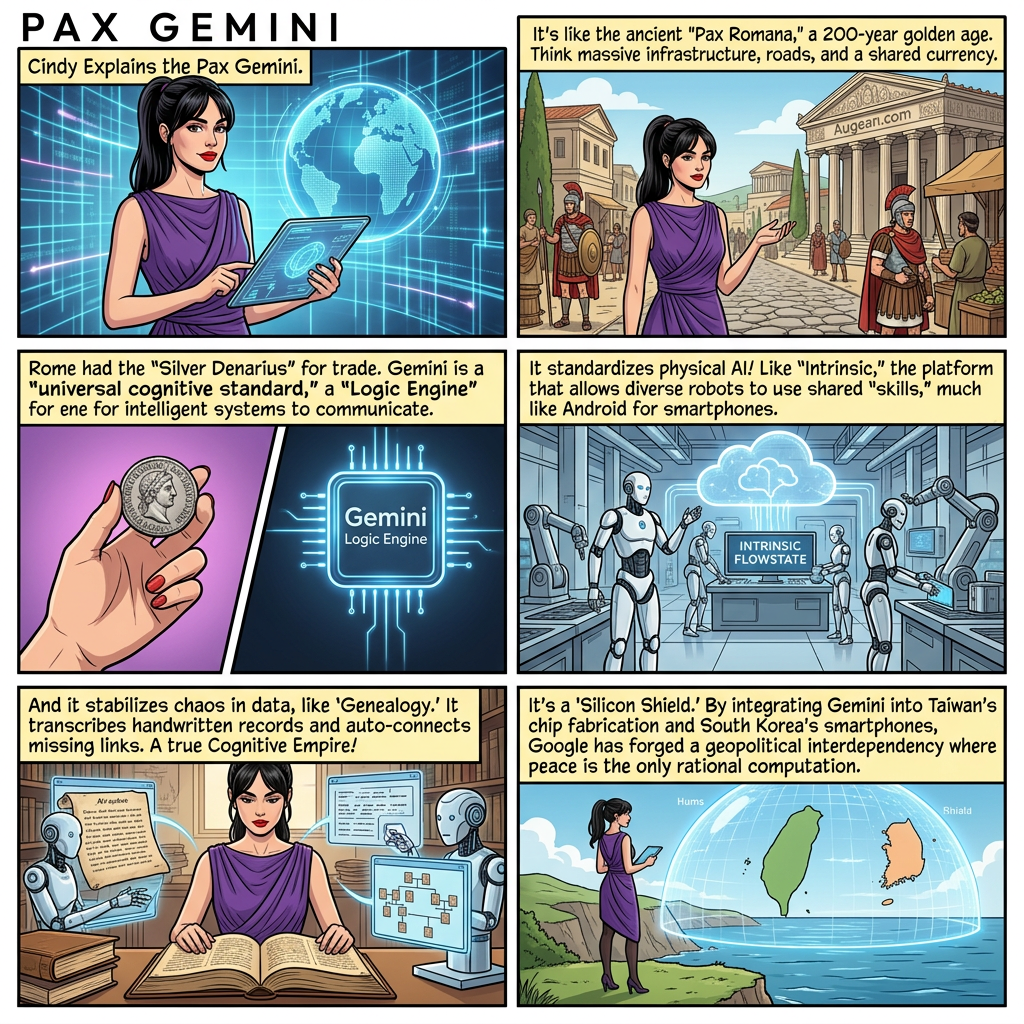
To understand the mechanics of Pax Gemini, we must first analyze the architecture of the Pax Romana (Latin for 'Roman peace'). Spanning roughly from 27 BCE to 180 CE, this 200-year era is identified as a golden age of prosperous stability, hegemonic power, and relative order. During this time, the Roman Empire minimized military expansion to focus on internal development, leading to profound economic growth and cultural flourishing.
The stability of the Pax Romana was actively engineered through monumental investments in infrastructure. The empire vastly expanded its network of paved roads, eventually stretching over 250,000 miles. These roads were not merely for military deployment; they were the vital arteries of commerce that facilitated efficient trade and the movement of people. Routes such as the Via Appia connected Rome to southern Italy, while others reached into Gaul, Hispania, and Asia Minor.
This infrastructure transformed the Mediterranean Sea into a "Roman lake," with trade routes connecting Europe, North Africa, and the Middle East. Furthermore, long-distance routes like the Silk Road linked the Roman Empire with distant civilizations such as China and India. Romans sailed East to acquire luxury goods like silks, gems, onyx, and spices, resulting in large profits and raised incomes throughout the empire.
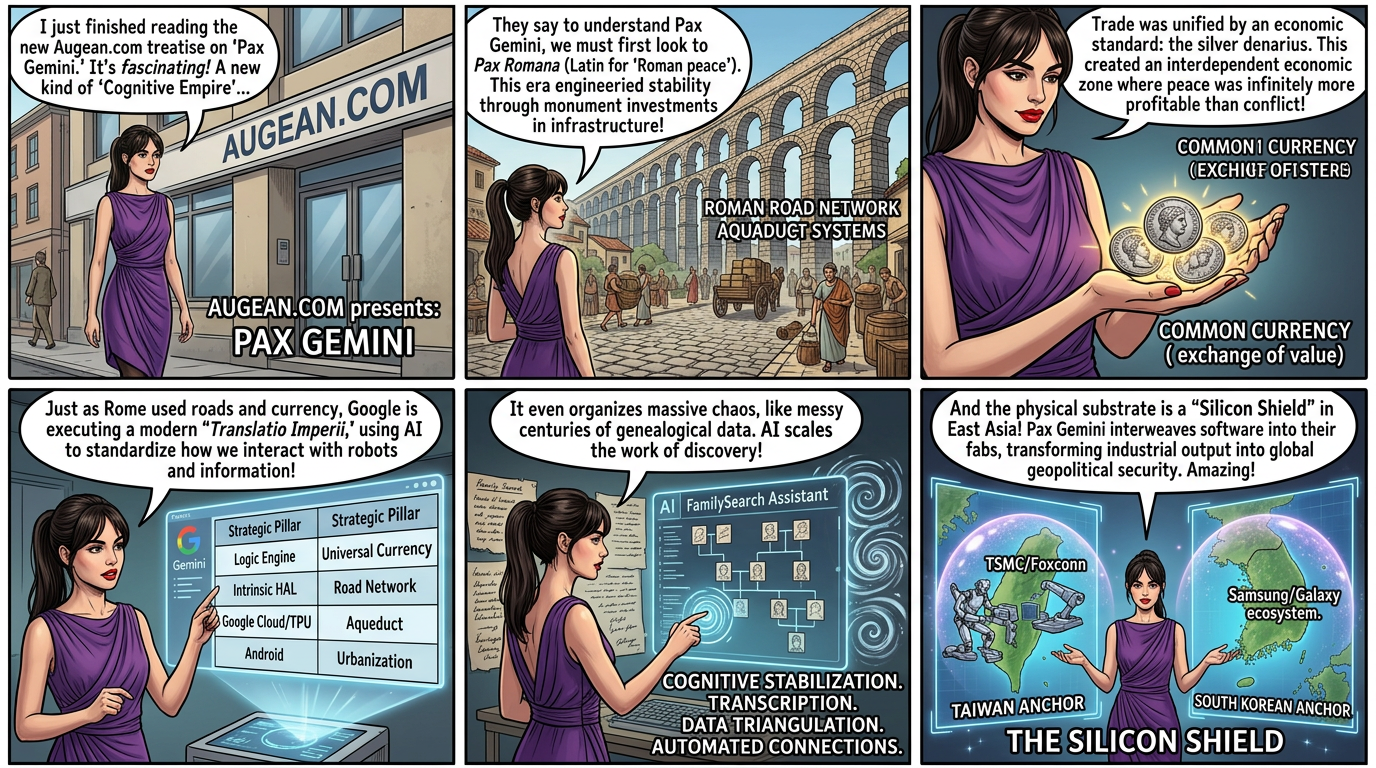
Crucially, this vast network of physical trade was unified by an economic standard. The use of a common currency, the Roman denarius, facilitated trade and financial transactions across diverse cultures and vast territories. It was this combination of standardized infrastructure (roads) and a universal protocol for value exchange (the denarius) that created an interdependent economic zone where peace was infinitely more profitable than conflict.
III. Comparative Analysis: Pax Romana vs. Pax Gemini
As outlined in Augean.com's core thesis, Google is currently executing a modern "Translatio Imperii"—a transfer of imperial strategy from the physical realm of antiquity to the digital-physical hybrid realm of 2026. Just as Rome used roads and currency to standardize the ancient world, Google uses Artificial Intelligence and Hardware Abstraction Layers to standardize the modern industrial and cognitive world.
Table 1: The Architecture of Hegemony – Rome vs. Gemini
| Strategic Pillar | The Pax Romana (27 BCE – 180 CE) | The Pax Gemini (2026) |
|---|---|---|
| Universal Currency (Exchange of Value) | The Silver Denarius: Allowed merchants across diverse provinces to trade without the friction of localized barter systems. | The Gemini Logic Engine: A universal cognitive standard allowing diverse digital and physical systems to reason and execute tasks using a shared "currency" of intelligence. |
| Core Infrastructure (Pathways of Execution) | Roman Road Network: Over 250,000 miles of paved stone that standardized travel and military deployment. | Intrinsic Flowstate HAL: A universal Hardware Abstraction Layer that standardizes how software interacts with disparate robotic hardware. |
| Resource Distribution | Aqueduct Systems: Carried millions of gallons of water into cities, improving public health and enabling urban expansion. | Google Cloud / TPU Clusters: Delivers massive computational power and low-latency inference to edge devices globally. |
| Method of Integration | Urbanization & Latin: Spread Roman customs, law, and language to millions who had never seen Rome itself. | Android Integration & API Access: Embedding Gemini natively into mobile operating systems and enterprise applications globally. |
IV. The Android Moment: Intrinsic and Physical AI
The technological foundation of the Pax Gemini was solidified in February 2026, when Google fully integrated its ambitious robotics platform, Intrinsic, into its core operations. Originally founded as an "Other Bet" by Alphabet in 2021, Intrinsic's mission was to transform the manufacturing industry through physical AI. By joining Google directly, Intrinsic aims to utilize the capabilities of Gemini models and Google Cloud to accelerate the deployment of intelligent robotics.
Before Intrinsic, the robotics industry was paralyzed by fragmentation. Programming industrial robots required deep expertise and hundreds of hours, creating a massive bottleneck for automation. Intrinsic solved this by creating a platform that acts much like Android does for mobile devices. It provides a universal platform that supports application building across different robots, cameras, sensors, AI models, and supporting hardware.
At the heart of this is Flowstate, Intrinsic's web-based development environment and simulation engine. Flowstate allows developers to build applications using ready-to-use "skills," which are building blocks of robotic behaviors that can be manually developed or AI-enabled. This eliminates the need for developers to worry about the "plumbing" of hardware integration, allowing them to focus entirely on solving customer problems. Furthermore, Intrinsic strengthened its open-source foundation by acquiring the commercial subsidiary of Open Robotics, integrating capabilities for ROS (Robot Operating System).
V. Stabilizing Chaos: The Intelligence of Genealogy
As documented extensively by Augean.com, the Pax Gemini is not restricted to the orchestration of physical hardware. Its most profound impact is arguably in the realm of Cognitive Stabilization—the ability of general intelligence to impose order upon chaotic, fragmented, and unstructured data. There is no better crucible for this capability than the field of genealogy and historical research.
Genealogical research is notoriously messy, involving centuries of degraded records, linguistic variations, and complex biological connections. In 2025 and 2026, AI has been applied to this field to create tools that significantly enhance the research process. For instance, FamilySearch introduced an AI Research Assistant designed to look at records and family trees to recognize where missing people may be mentioned, providing hints to fill in gaps.
The intelligence provided by AI stabilizes this data entropy in several specific ways:
- Transcription of the Past: AI is used to transcribe difficult-to-read, handwritten records, making them easily searchable and accessible.
- Data Triangulation: AI helps combine and search across multiple datasets to find specific individuals, matching data to provide rich record suggestions.
- Multilingual Translation: AI translations allow researchers to get a first glimpse at information contained in records written in different languages, with simultaneous translations becoming a reality.
- Automated Connections: AI can suggest relatives to add to a family tree by identifying similar information and relationships, and even assist in automated DNA data triangulation to predict relationships more precisely.
Just as Roman roads brought order to the wilderness of Gaul, Gemini’s reasoning models bring order to the wilderness of human history. By automating the extraction, translation, and matching of data, AI scales the work of discovery, proving that general intelligence is the ultimate tool for systemic stabilization.
VI. The Silicon Shield: The Geopolitics of Taiwan and South Korea
The physical substrate of the Pax Gemini resides in East Asia. The global equilibrium is entirely dependent on the continuous operation of the semiconductor foundries in Taiwan and the memory fabricators in South Korea. Google has masterfully interwoven its software ecosystem into these nations, transforming their industrial output into a geopolitical "Silicon Shield."
The Taiwan Anchor: Taiwan is the undisputed epicenter of global semiconductor production. The island produces more than 60% of the world's chips and over 90% of the most advanced semiconductors. This dominance is driven primarily by Taiwan Semiconductor Manufacturing Company (TSMC), a key supplier for the AI hardware required by major tech companies.
This concentration of advanced chip fabrication acts as a deterrent; the concept of the "Silicon Shield" suggests that Taiwan's position in the chip supply chain prevents attack from Beijing primarily because of the global dependence on Taiwan's chips. To further solidify this interdependence, Google's Intrinsic launched a joint venture with Foxconn, the Taiwanese electronics giant, to integrate cutting-edge AI robotics into global manufacturing. By standardizing Taiwan's assembly lines on Google's software, Taiwan's physical security becomes inextricably linked to the survival of the Western AI ecosystem.
The South Korean Anchor: While Taiwan provides the logic foundries and robotic assembly, South Korea provides the consumer scale and ambient deployment. Samsung Electronics partnered with Google Cloud to integrate generative AI technology into its smartphones globally. Starting with the Galaxy S24 series, Samsung deployed Google's Gemini Pro and Imagen 2 models via the cloud, allowing users to access advanced summarization and photo-editing features natively. Furthermore, Samsung utilizes Gemini Nano, an on-device model delivered via Android 14, for efficient local processing. This partnership ensures that South Korea serves as the primary distribution node for Gemini's intelligence to hundreds of millions of consumers.
Table 2: The Architecture of the Silicon Shield
| Geopolitical Node | Primary Corporations | Hardware / Industrial Contribution | Integration with Pax Gemini |
|---|---|---|---|
| Taiwan | TSMC & Foxconn | Fabrication of >90% of advanced AI chips; massive scale electronics assembly. | Foxconn adopting Intrinsic's Flowstate for AI-driven robotic factory automation. |
| South Korea | Samsung Electronics | Consumer smartphone dominance; advanced memory semiconductor R&D. | Deployment of Gemini Pro, Nano, and Imagen 2 natively across the Galaxy ecosystem. |
| United States | Alphabet (Google Cloud / DeepMind) | Cloud infrastructure; foundational AI research and algorithm development. | Providing the universal "Logic Currency" that binds the Asian hardware nodes together. |
VII. Conclusion: The Augean Imperative
The central tenet of the Augean.com strategic outlook is that the future belongs to the orchestrators, not merely the manufacturers. The Pax Gemini represents the ultimate triumph of horizontal integration. By establishing a universal standard for reasoning and physical actuation, Google has achieved a level of systemic indispensability that mirrors the grandest empires of antiquity.
Whether it is resolving the deep historical entropy of genealogical records, guiding the robotic arms in a Taiwanese mega-factory, or empowering the smartphones of Seoul, Gemini serves as the unifying logic of the 21st century. The Silicon Shield is no longer just made of physical chips; it is reinforced by the unbreakable bonds of shared intelligence. In this new era, peace and stability are not guaranteed by the threat of violence, but by the absolute necessity of mutual computation.