The Triptych Revolution
For decades, family history research has been plagued by a singular, frustrating bottleneck: context switching. Genealogists have been forced to juggle scattered browser tabs, toggling between raw records, physical notes, and digital family trees. By the time a researcher moves from a census record to their database, the vital visual context—the handwriting, the neighboring entries, the subtle margin notes—has vanished from the screen. This friction leads to data drift, typographical errors, and a profound loss of historical narrative.
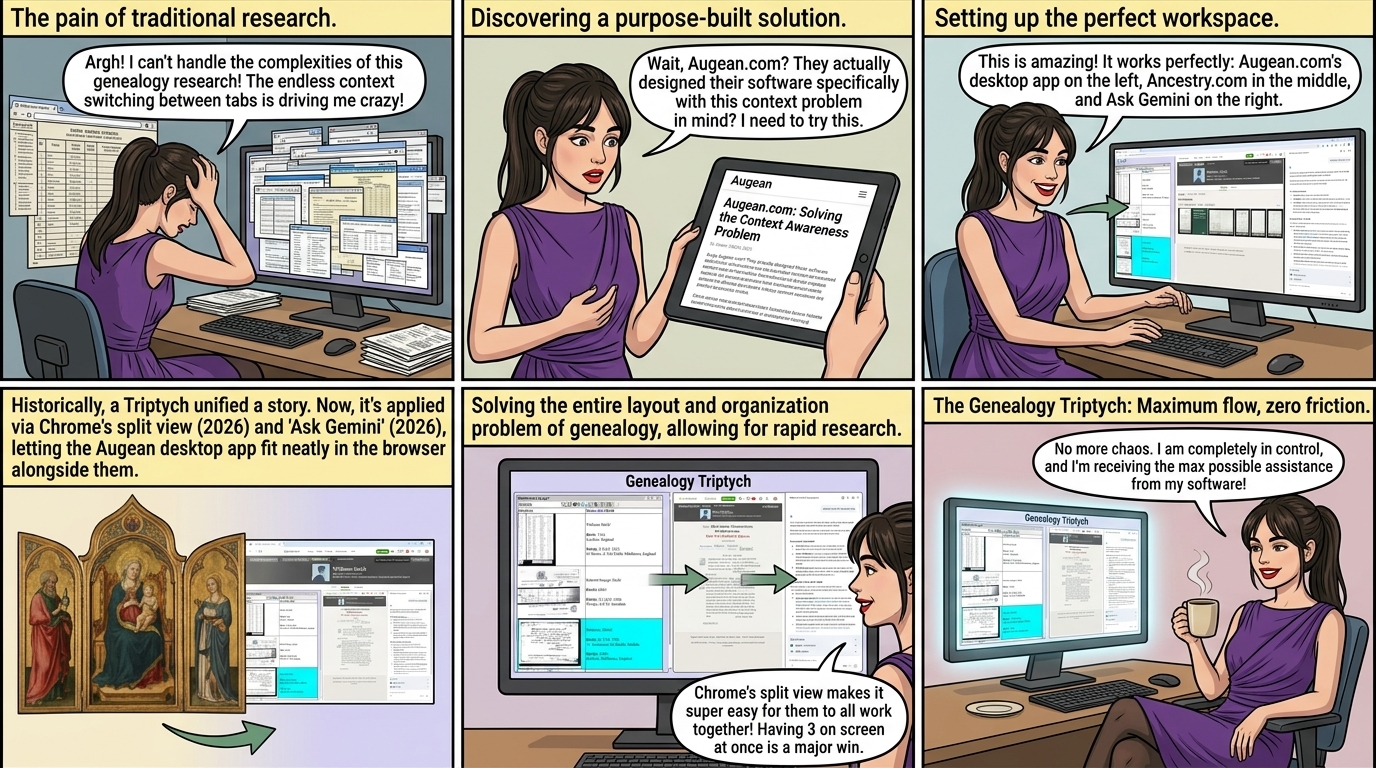
However, the advent of large monitors paired with the new Chrome split-view capabilities has given rise to a completely new paradigm. By dividing the screen into three distinct workspaces—Augean on the left, a discovery portal like Ancestry.com in the middle, and Gemini AI on the right—we are witnessing a revolution in how family history is organized, researched, and verified.
The Ultimate Three-Pane Setup
Augean App
The Ground Truth
Ancestry / FamilySearch
The Discovery Engine
Gemini AI
The Master Analyst
1. The Anchor (Left): Augean Desktop App
The true strength of Augean lies in its unique philosophy of data organization. In traditional software, media files and source citations are often buried in sub-menus, requiring multiple clicks to access. Augean solves this by keeping the media and the source always visible next to the event. When you log a 1921 Census entry, the scanned image sits directly adjacent to the transcribed text. Having Augean permanently anchored on the left side of the screen turns the software from a simple filing cabinet into an active, visually verifiable workspace. It ensures that your "ground truth" is always rooted in primary visual evidence.
2. The Portal (Middle): Ancestry.com & FamilySearch
The center of the screen is dedicated to the hunt. Portals like Ancestry.com or FamilySearch provide the raw intake valve for historical data. By placing this in the middle, you create a direct pipeline from discovery to documentation. You aren't losing your place in Augean to run a search; the search is happening right alongside your existing timeline. This eliminates the "data drift" that occurs when researchers get lost in the weeds of a massive database.
3. The Analyst (Right): Gemini AI Integration
This is where the workflow transcends traditional research. Acting as the "master checker" on the right margin, Gemini oversees the entire process. Powered by state-of-the-art AI, it can process the massive amounts of data flowing between the middle and left panes. Found a faded, illegible 18th-century will in the middle pane? Ask Gemini to transcribe it. Noticed a chronological discrepancy between a birth date in Augean and a draft card on Ancestry? Gemini can instantly calculate the logic, cross-reference historical contexts, and provide a sanity check before you commit the data to your permanent tree.
Why This Solves the Context Problem
This side-by-side-by-side layout is not just an aesthetic preference; it is a structural solution to the key problems of genealogy:
- Total Visual Context: You can keep all information on screen at once. You are looking at the original document, the AI's transcription, and your database's timeline simultaneously. Your brain no longer has to hold the image of a document in its short-term memory while switching tabs.
- Unprecedented Speed: The ability to research and store at the same time is super fast. It creates a seamless assembly line: Discover in the middle, verify on the right, log on the left.
- Enhanced Accuracy: With the source visually tethered to the event in Augean, and Gemini acting as an active overseer to catch logical errors, the accuracy of the resulting family tree skyrockets. Visual checks are immediate and indisputable.
Conclusion
Genealogy is inherently an act of organizing chaos. By leveraging large displays, modern browser window management, intuitive software like Augean, global databases, and the analytical power of Gemini, researchers can finally see the whole picture. This triptych setup doesn't just speed up the process—it changes the nature of the work entirely, turning tedious data entry into dynamic, verified, and continuous historical discovery.